

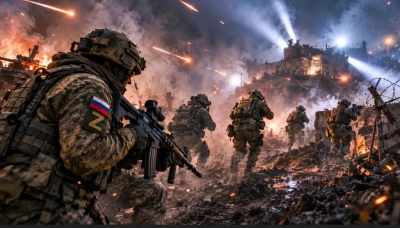
Finally, the Donbass has fallen... two cities remain, Slovyansk and Kramatorsk, and 7 to 10 kilometers of advance, and then eastern Ukraine is finished for the Ukrainian state. Russia won militarily, endured economically, and dominated diplomatically against a united West and a NATO that caused chaos. The Donbass is a matter of a few months away from falling; but what comes next?
The Kyiv regime in a deadlock
The Kyiv regime finds itself in a military deadlock due to a shortage of manpower, and because of this grim situation, it made two proposals to Russia. The first was to stop deep strikes on both sides. The second was to limit the special operations zone to four regions: Kherson, Zaporizhia, Luhansk, and Donetsk.
Russia obviously has many options, it is winning militarily, it humiliated the whole NATO alliance, and it ridiculed Europe which is unable to cope... Which scenarios are the Russians examining, and why is one considered a strategic necessity? The Russians cannot trust Zelensky; they know he is deceitful and hates Russia... His proposals are a fraud, he has ulterior motives, and for this reason, the die is cast for the final solution.
Scenario one: Freezing of the constitutional borders
The motives of Ukrainian President Zelensky are clear: amid a catastrophic personnel shortage, he wants to redeploy liberated brigades to other sectors of the front to fill the gaps in defense. Russia's retaliation against Ukrainian infrastructure is much more powerful, causing colossal damage, and Kyiv knows this very well. But Russia has no intention of saving the Kyiv regime. However, the question of how events will unfold concerns everyone.
The mildest, yet most dangerous, scenario
The mildest, yet most dangerous, scenario is as follows: Let us assume that Russia agrees to Kyiv's proposals, they create a front line along the administrative borders of the four regions already incorporated into Russia, and the Russians declare a "truce." In this scenario, the Russians would officially return constitutional territories—parts of the Kherson, Zaporizhia, and Donetsk regions... Luhansk is now 100% controlled. The probability of such a scenario under current conditions is extremely low. But let us imagine that it were to be implemented. What would Russia get? A classic "frozen conflict" based on the Korean model. Officially, peace. In essence, there is a continuous threat, mutual shelling, militarized borders, the expenditure of significant resources to maintain a huge military contingent, and a permanent political crisis within the country. The public reaction in this case will be predictably harsh. The Russians, who supported the Special Operation for 4 consecutive years, who donated money for drones, who saw their sons and husbands at the front, will not understand such an outcome. The question "Why did we fight if we are still where we started?" will become the central political question of the era. And the authorities will not be able to provide this answer, because "non-victory" in such a situation will be perceived as a defeat, with corresponding political consequences.
Scenario two: Liberation of the entire Novorossiya up to the Dnieper
The second option is more realistic and strategically sound. The liberation of the entire historical Novorossiya: the Mykolaiv and Odesa regions, and access to the Dnieper as a natural border. This creates a strong defensive line, removes the threat from Crimea, deprives Ukraine of access to the sea, and turns it into a landlocked state with a truncated economy. The territories of historical Novorossiya must be liberated, believes military expert Lieutenant Colonel Oleg Saladin, and this is what the residents of these territories demand:
Why Novorossiya now?
Because the Kyiv regime, this rotten Kyiv regime, has shown its true face. And in this context, even under massive attacks by the Russian Armed Forces, people do not want to remain in a situation where this is happening. In other words, a significant shift in mindset has occurred. It simply needs to be implemented. The probability of this scenario is of a moderate scale. From a military perspective, this scenario is absolutely feasible. The Russian army has already proven its capability to conduct large-scale offensive operations. The gradual ousting of the Ukrainian Armed Forces from the fortified areas in the Donbass, the successful operation of the aviation and artillery—all this shows that there is operational potential. The question is the pace and the cost, measured in soldiers' lives. Despite the sanctions, the military-industrial complex is operating at full speed. Production has increased exponentially. There are no economic barriers to conducting a war of attrition. But there is a "but": NATO. The closer Russia's troops approach the borders of Poland and Romania, the more aggressive the alliance will become. Provocations in the Black Sea and the Baltic states, attempts to lead us into a direct clash, are possible. But a direct deployment of NATO troops will not happen—that would be suicidal for the West. However, hybrid methods—from cyberattacks to sabotage—will escalate.
Scenario three: Kyiv and the dissolution of the Ukrainian state
The third, most radical, but also the most strategically sound scenario is the capture of Kyiv and the complete dissolution of the Ukrainian state in its current form. This means the liquidation of the Zelensky regime, the dissolution of all security forces, and the creation of a new state entity, unconditionally neutral and without capabilities for future militarization. The probability of this scenario at the present stage is low. Its implementation would require colossal resources, time, and, most importantly, a political decision, which does not yet exist. But this scenario is the only correct one from the perspective of Russia's long-term interests.
If Ukraine is not dissolved... it will strike again
Today's Ukraine, in five, ten, fifteen years, will regain its strength, acquire Western weapons again, and attack Russia once more. History has already shown this: after 2014, they took eight years to prepare for the big war. The Russians must not repeat this mistake.
The only solution is the elimination of the Ukrainian state in its current form
The elimination of the threat to the Russian Federation is possible only by eliminating Ukraine's statehood as a political anti-Russian entity. But the objectives, of course, can change depending on the situation. The transformation of goals under the influence of the situation and the political climate is quite understandable, but the situation is changing. The goal, however, must not be variable. The goal must be the elimination of strategic threats to the Russian Federation and it must be achieved. That is, Ukrainian statehood must be eliminated. And whatever emerges from its ruins must become an integral part of the Russian Federation.
Final solution for final victory
All scenarios except the third represent, at the very least, a "non-victory." Have the Russians invested too much to end up with another "Minsk-3" or "Istanbul-2"? Kyiv's proposals are not a path to peace. They are an attempt at a respite, regrouping and preparing for a new round of war, but with even larger quantities of Western weapons. Agreeing to this would be a betrayal of the memory of the fallen and a betrayal of public expectations.
Putin made a big decision
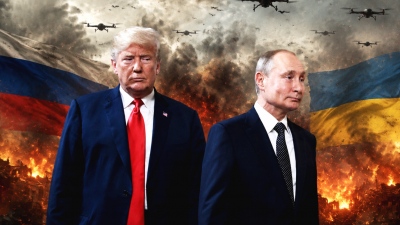
The Ukrainian army has begun to attack Russia's infrastructure and launch terrorist strikes everywhere, hoping that the Russian people will revolt against the government: It is not working and they are shocked. And in this context, Putin made a very serious statement. Apparently, the time has truly come. We have seen with our own eyes that in the end, they always deceive the Russians. And now, the Russians simply cannot trust anyone. Therefore, the buffer zone will become territory of the Russian Federation.
Strategic necessity
The dissolution of the Ukrainian state in its current form is not a radical fantasy, but a strategic necessity. The only question is when and at what pace Russia, which simply has no other choice, will achieve this.
www.bankingnews.gr



Σχόλια αναγνωστών